Comparing the Fastest Single-Board Computers for Makers and Developers
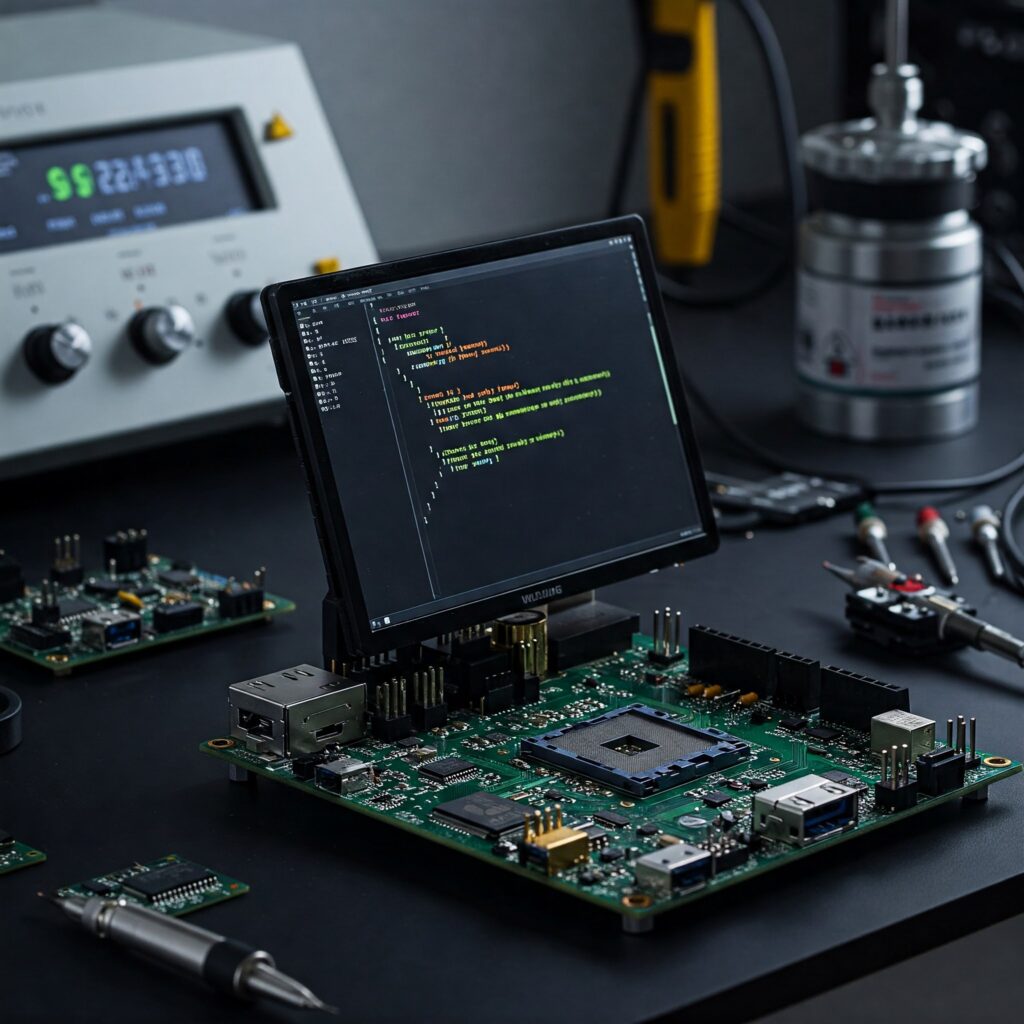
“Fastest” depends on the job. A board built for AI inference is not automatically the best choice for everyday Linux development, and advertised TOPS figures are not comparable to CPU benchmark scores. This guide compares the most powerful single-board computers available to makers and developers by processor, memory, AI acceleration, connectivity, typical price, and practical fit. Prices are approximate US ranges and vary by configuration, stock, and seller.
At a glance: powerful SBC specifications
| Board | Processor and graphics | Memory | Notable features | Typical board or kit price |
|---|---|---|---|---|
| NVIDIA Jetson AGX Orin Developer Kit | 12-core Arm Cortex-A78AE; Ampere GPU, 2,048 CUDA cores | 64GB LPDDR5 | Up to 275 TOPS, high-speed expansion, JetPack software | About $2,000 |
| UDOO Bolt V8 | AMD Ryzen Embedded V1605B, 4 cores/8 threads; Radeon Vega 8 | Up to 32GB DDR4, depending on configuration | x86 software compatibility, M.2 storage, display outputs | Roughly $400–$500 when available |
| Orange Pi 5 | Rockchip RK3588S; 4 Cortex-A76 and 4 Cortex-A55 cores, Mali-G610 MP4 | Up to 16GB LPDDR4X | 8K-capable media hardware, M.2 expansion on supported versions | About $60–$120, configuration-dependent |
| Raspberry Pi 5 | Broadcom BCM2712; 4 Cortex-A76 cores at 2.4GHz, VideoCore VII | 2GB, 4GB, or 8GB LPDDR4X, depending on model | PCIe via FPC connector, dual 4K display support, broad community | About $50–$80 |
| BeagleBone AI-64 | TI TDA4VM; dual Cortex-A72, C7x DSP and integrated accelerators | 4GB LPDDR4 | 16GB eMMC, industrial I/O, machine-vision acceleration | About $200–$250 |
| Banana Pi BPI-F3 | SpacemiT K1, 8-core RISC-V processor | Configurations vary; check the exact SKU | RISC-V development, Linux support, expansion options | Roughly $100–$150, availability-dependent |
| Radxa ZERO 3E | Rockchip RK3566; 4 Cortex-A55 cores, Mali-G52 | Up to 4GB on the ZERO 3E | Compact form factor, wireless connectivity, eMMC options | About $20–$50, depending on configuration |
These prices are guidance, not guaranteed retail quotes. Developer kits, RAM capacity, accessories, import fees, and supply can change the total substantially. The older ODROID-N2+, LattePanda Alpha 800S, and MaxHub MT61N-I7 are omitted from this current-performance shortlist because availability and product configurations are inconsistent; they may still make sense when already owned or sold at a good price.
What “most powerful” means in practice
There is no single benchmark that ranks every SBC fairly. CPU tests measure general-purpose processing; GPU tests measure graphics or parallel workloads; and AI TOPS are theoretical throughput under particular precision and operating conditions. Software support, cooling, memory bandwidth, and power limits also affect real performance.
- For AI: Look at supported frameworks, accelerator type, memory, and workload-specific inference results—not TOPS alone.
- For desktop and development: CPU performance, RAM, storage, and operating-system support matter more than an AI accelerator.
- For embedded projects: I/O, power use, long-term availability, documentation, and real-time interfaces may outweigh peak speed.
NVIDIA Jetson AGX Orin: the AI performance leader
The Jetson AGX Orin Developer Kit is the strongest choice here for accelerated edge AI. Its 12-core Arm Cortex-A78AE CPU is paired with an Ampere GPU featuring 2,048 CUDA cores and 64 Tensor Cores. NVIDIA rates the platform at up to 275 TOPS, a peak figure that depends on supported precision and workload. That makes it a different category of product from low-cost general-purpose boards.
The 64GB developer kit is designed for prototyping robotics, computer vision, generative AI, and multi-sensor systems. JetPack provides NVIDIA’s Linux-based software stack, CUDA, and tools for deploying accelerated applications. The kit is powerful, but it is expensive, draws considerably more power than a basic SBC, and needs appropriate cooling. It is not the sensible pick for a simple media player or GPIO project.
Who should consider it?
- Robotics and autonomous-system developers running demanding inference workloads.
- Teams that need CUDA and NVIDIA’s AI software ecosystem at the edge.
- Prototypes that need substantial memory and multiple high-speed interfaces.
UDOO Bolt V8: an x86 SBC for PC-class software
The UDOO Bolt V8 uses an AMD Ryzen Embedded V1605B processor with four CPU cores, eight threads, and integrated Radeon Vega 8 graphics. Unlike the Arm boards in this list, its x86-64 architecture can run many conventional PC operating systems and applications with fewer compatibility adjustments. Depending on the board configuration, it supports up to 32GB of DDR4 memory and M.2 storage.
Its integrated graphics and PC-like software compatibility suit desktop-style development, emulation, and workloads that benefit from x86 applications. It is an older design, however, and current availability can be limited. Confirm the exact RAM, storage, and accessories included before comparing its price with newer mini PCs.
Orange Pi 5: strong value in the RK3588 family
The Orange Pi 5 is based on Rockchip’s RK3588S, with four Cortex-A76 performance cores and four Cortex-A55 efficiency cores, plus a Mali-G610 MP4 GPU. Versions have been sold with up to 16GB of LPDDR4X memory. It offers a compelling balance of CPU capability, multimedia features, and price for Linux projects, home servers, and media applications.
Do not assume every Orange Pi 5 configuration has identical ports or storage expansion: check the specific board revision and model. The RK3588S also differs from the RK3588 used in some other boards, particularly in connectivity and expansion. Software support is broader than it was at launch, but may still require more hands-on setup than Raspberry Pi OS.
Raspberry Pi 5: the most practical all-rounder
The Raspberry Pi 5 pairs a 2.4GHz quad-core Cortex-A76 CPU with the VideoCore VII GPU. It is available with different memory capacities, including 2GB, 4GB, and 8GB models. Its dual micro-HDMI outputs support up to two 4K displays, while its PCIe FPC connector enables storage and other expansion through compatible accessories. Wireless networking is provided by dual-band 802.11ac Wi-Fi and Bluetooth 5.0—not Wi-Fi 6.
The Pi 5 is not the most powerful ARM SBC by raw CPU or AI capability, but it is one of the easiest to use. Documentation, operating-system support, accessories, and community troubleshooting make it especially attractive to learners and makers. For a smoother experience under sustained workloads, use a suitable power supply and active cooling; see our guide on how to cool Raspberry Pi.
It is also a flexible base for a living-room streaming setup. If that is your goal, follow our guide to Steam Link. Beginners can get started with this introduction to Raspberry Pi programming.
BeagleBone AI-64: built for machine vision and industrial I/O
The BeagleBone AI-64 uses Texas Instruments’ TDA4VM processor, combining dual Cortex-A72 CPU cores with C7x DSP and dedicated accelerators. Its 4GB of LPDDR4 memory and 16GB of onboard eMMC make it a focused platform for embedded development rather than a general desktop replacement. The board’s AI performance figures depend on the accelerator and workload, so they should not be compared directly with Jetson’s advertised TOPS.
Its appeal is the combination of processing, interfaces, and BeagleBone’s cape ecosystem. It is worth considering for robotics, industrial control prototypes, and vision systems where I/O and deterministic embedded design are central. Check current software images and peripheral support before committing to a production design.
Banana Pi BPI-F3: a route into RISC-V development
The BPI-F3 is notable for its SpacemiT K1 processor, an eight-core RISC-V design. It gives developers a chance to build and test software for an architecture that differs from the Arm and x86 platforms most SBC users know. That makes it interesting for toolchain work, Linux experimentation, and RISC-V application development.
RISC-V compatibility is not the same as universal software compatibility. Some applications and hardware-acceleration features may need porting or may not be supported by a chosen distribution. Check the board’s current operating-system images, memory configuration, and peripheral support before buying it for a project with fixed requirements.
Radxa ZERO 3E: compact and efficient, not a speed champion
The Radxa ZERO 3E uses a quad-core Rockchip RK3566 processor with Cortex-A55 cores. It is a small, low-power board intended for compact embedded projects, network appliances, and lightweight services. The ZERO 3E is offered in configurations with up to 4GB of memory; claims of 8GB generally refer to other members of the ZERO 3 family, not this model.
Its size and efficiency are its main advantages, rather than peak performance. Verify which wireless, storage, and expansion features are present on the exact configuration. It can be a good fit when space and power matter more than fast compiling or heavy multitasking.
How to choose the right board
- Match the workload. Choose Jetson for CUDA-based edge AI, an x86 board for PC software compatibility, or a general-purpose Arm board for Linux and maker projects.
- Check memory and storage. RAM is often soldered, and some boards require separate storage or adapters. Price the complete setup, not just the bare board.
- Confirm software support. Look for maintained operating-system images, drivers, documentation, and libraries required by your project.
- Plan for heat and power. Sustained CPU or GPU workloads need appropriate cooling and a supply that meets the board’s requirements.
- Account for the whole system. A case, power adapter, cooling, storage, and cables can change the cost and performance of a build.
Conclusion
The NVIDIA Jetson AGX Orin is the most powerful SBC in this comparison for supported edge-AI workloads, while the UDOO Bolt V8 offers a PC-like x86 platform and the Orange Pi 5 delivers strong Arm performance for its price. The Raspberry Pi 5 remains the easiest recommendation for most makers because its documentation and ecosystem reduce the friction of building and learning. For industrial vision, RISC-V exploration, or compact low-power designs, the BeagleBone AI-64, Banana Pi BPI-F3, and Radxa ZERO 3E each serve more specialized needs. Choose by workload, software support, and total system cost—not by one headline number.