If you’ve ever thought about adding an affiliate program to your Shopify store, you’ve probably also thought about what it would take to build one.
Tracking referral links, attributing sales to the right affiliate, calculating commissions, managing payouts are all non-trivial engineering problems, and rolling your own solution is rarely worth the time (and to be honest you don’t have to).
There are purpose-built tools that handle all of this natively inside Shopify, so you can launch a fully functional affiliate program without writing a single line of tracking code.
This guide walks through how affiliate programs work technically, what you actually need to set one up, and also the best app to go for.
What Is a Shopify Affiliate Program?
A Shopify affiliate program lets you recruit external partners (e.g; bloggers, creators, existing customers, or niche communities) to promote your store’s products in exchange for a commission on the sales they generate.
Each affiliate gets a unique referral link or coupon code and when someone clicks that link and makes a purchase, the sale is attributed to the affiliate and a commission is logged.
Under the hood, this requires:
- Link generation: unique, trackable URLs per affiliate
- Cookie-based attribution: storing a session cookie so the sale is credited even if the customer doesn’t buy immediately
- Conversion tracking: a post-purchase hook that fires when an order completes
- Commission logic: flat rates, percentages, or tiered structures depending on your program rules
- A payout system: calculating what’s owed and getting money to affiliates
Building all of that yourself on top of Shopify’s API is doable, but it’s weeks of work, ongoing maintenance, and edge cases you haven’t thought of yet.
Most developers are better off owning the strategy and letting a dedicated tool own the infrastructure. Besides, there are really cheap apps on the Shopify app store
What to Look for in a Shopify Affiliate App
Not all affiliate apps are created equal. Before picking one, consider the following:
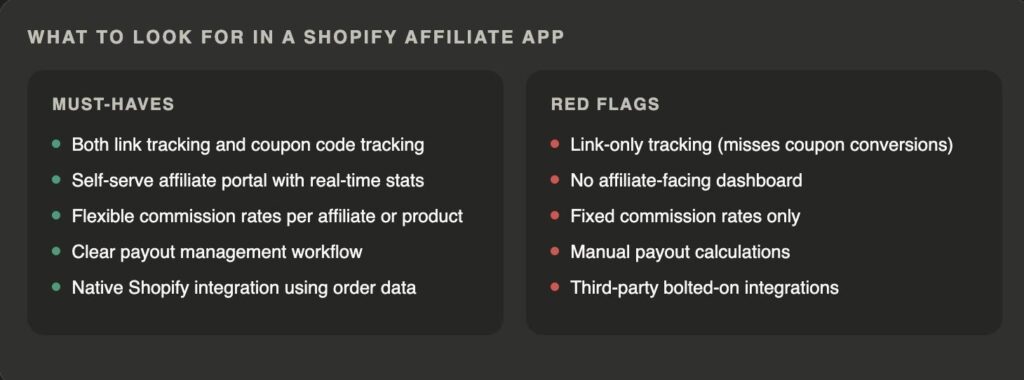
- Attribution accuracy: Does it support both link tracking and coupon code tracking? Some customers never click a link but use a code at checkout. You want both covered.
- Affiliate portal: Affiliates need visibility into their own performance. A self-serve dashboard where they can grab links, check their sales, and view pending commissions reduces the support load on your team.
- Commission flexibility: Can you run different commission rates for different affiliates or products? Flat percentage programs work at the start, but you’ll eventually want tiered or custom rates for top performers.
- Payout management: How does money actually get to affiliates? Manual, automated, or integrated with a payment provider?
- Native Shopify integration: Does it feel like part of Shopify or a bolted-on third party? Native apps that use Shopify’s own order data are generally more reliable and less prone to attribution gaps.

One of the best apps on Shopify that offers all these and more is an app called Affilitrak. Affilitrak is simple, has all the best features for affiliate marketing and their team also updates the app regularly based on what their users need. For simplicity sake, Affilitrak will be our app of focus
How Affilitrak Handles the Technical Layer
For more context, Affilitrak is a Shopify-native affiliate management app built specifically for merchants who want to launch an affiliate program without the engineering overhead.
Here’s what it covers out of the box:
- Referral link and coupon tracking: Affiliates can use either a unique referral link or a custom coupon code (or both). Sales are attributed through either path, so you don’t lose conversions from customers who prefer typing in a discount code at checkout rather than clicking a link.
- Branded affiliate portal: Each affiliate gets a self-serve dashboard where they can generate product links, track their referred sales, view their commissions, and manage their account. You can host this portal on your own subdomain, so it looks like part of your store rather than a third-party tool.
- Commission programs: You can set flat commissions, percentage-based commissions, or build out ladder structures where commission rates increase as affiliates hit performance thresholds. Multiple programs can run simultaneously, which is useful if you want different terms for different affiliate tiers.
- Automated payouts: Commission calculations happen automatically based on the rules you configure. You set the payout schedule; Affilitrak handles the math.
- Quick Shopify setup: Because it integrates directly with Shopify’s order and product data, there’s no custom tracking code to install and no webhook configuration to manage manually. Install the app, configure your program, and start inviting affiliates.
Setting Up Your First Affiliate Program: A Practical Checklist
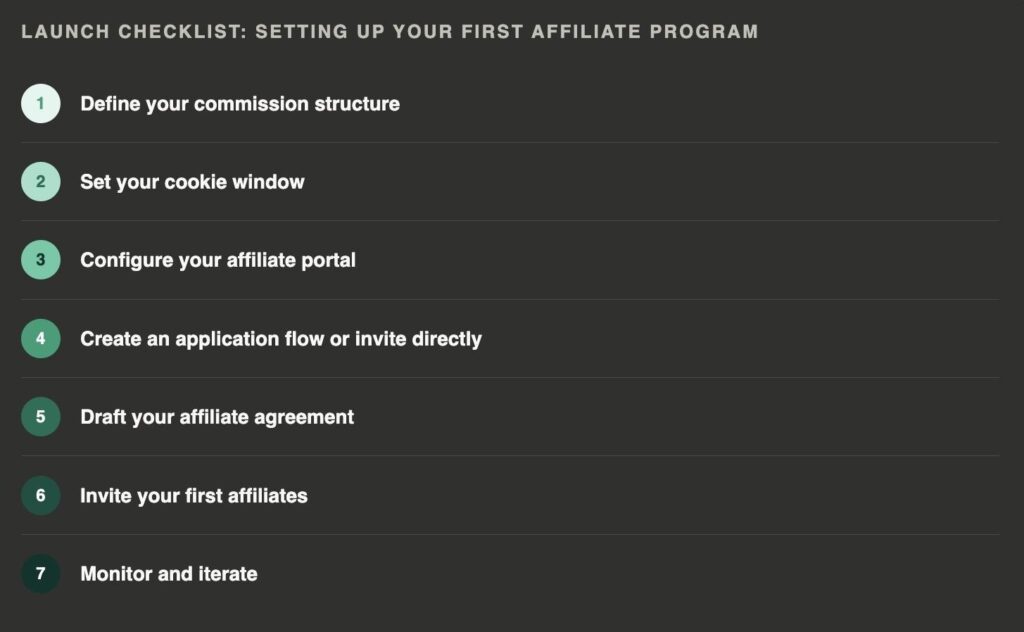
Once you’ve picked your tool, here’s what the launch process actually looks like:
- Define your commission structure: A flat percentage (10–20% is common for e-commerce) is easier to communicate to affiliates than a complex tiered system. But if you want more complex systems like a multi-level marketing commission system, coupons, ladder commissions and so on, apps like Affilitrak also has these features
- Set your cookie window: How long after clicking a referral link should an affiliate get credit? The standard is a 30-day attribution window. But you can also change the cookie window to the amount of days you want.
- Configure your affiliate portal: Set up your stores subdomain, add your branding, and write the welcome copy affiliates will see when they log in.
- Create an application flow or invite directly: Decide whether affiliates apply and get approved, or whether you invite specific people. Both models work; the right one depends on whether you want a curated or open program.
- Draft your affiliate agreement: Commission rates, payout schedules, prohibited promotion methods (e.g., no paid ads bidding on your brand terms). Put it in writing.
- Invite your first affiliates: Your best starting point is existing customers who already talk about your brand. They already know the product and have authentic audiences.
- Monitor and iterate: Track which affiliates are driving actual revenue, not just clicks. Adjust commission structures for top performers over time.

Conclusion
If you’re a developer evaluating whether to build your own affiliate tracking system, the honest calculus is this: the problem is well-solved. The edge cases (coupon stacking, refund handling, multi-touch attribution, affiliate fraud) are annoying to think through and even more annoying to debug in production.
Tools like Affilitrak exist precisely because this is a hard enough problem that it’s worth having a dedicated product around it. The engineering time you’d spend building and maintaining a tracking system is almost always better invested in your core product.
Install it, configure it, and focus on recruiting good affiliates. That’s where the actual growth happens.